Witness Accounts
Witness accounts have been valuable resources in efforts to raise awareness of the Holodomor, especially in the years before Soviet archives were open to research. Below is a list of online collections of Holodomor witness accounts, including audio and video recordings and written testimonies.
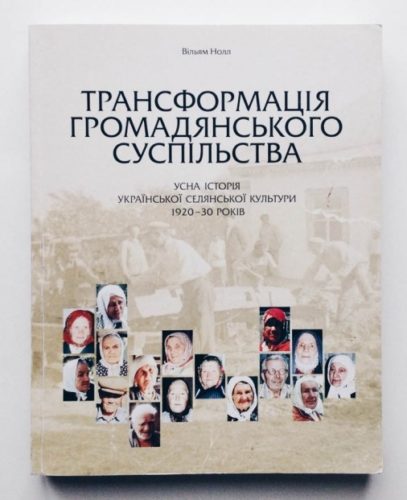
In 1993-95, a group of Ukrainian scholars led by Dr. William Noll, undertook a large-scale research project to collect first-hand accounts of village life and community organization prior, during, and after collectivization of the Ukrainian farmers. Using an elaborate and carefully crafted questionnaire, the researchers recorded 429 interviews with elderly Ukrainian villagers across the country. The collected testimonies served as primary data for the analysis of dramatic sociocultural changes the Ukrainian rural communities were forced to undergo in the 1920-30s. Select interviews were eventually profiled, in part, in a monograph by Noll, that came out in 1999 in Rodovid Publishing House, The Transformation of Civil Society: Oral History of Ukrainian Peasant Culture of the 1920-30s.
The website was created on the 80th anniversary of the Holodomor, and highlights the stories of 80 survivors living in Canada. The short video clips and transcripts of the interviews are a valuable resource for researchers and students. The project was organized by the Ukrainian Canadian Congress, the Ukrainian World Congress, and the Ukrainian Candian Research and Documentation Centre.
The website offers a register of survivors and victims of the Holodomor assembled by the Ukrainian Canadian Research and Documentation Centre in cooperation with the Ukrainian Canadian Congress. The information collected is intended for use by educational-academic purposes and for raising awareness about the Holodomor in both the Canadian and international communities.
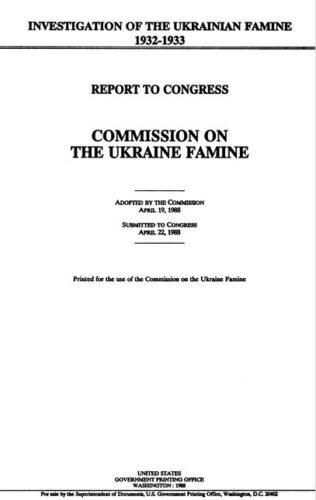
The “Report to Congress” of the Commission on the Ukraine Famine is available online through the Hathi Trust Digital Library.
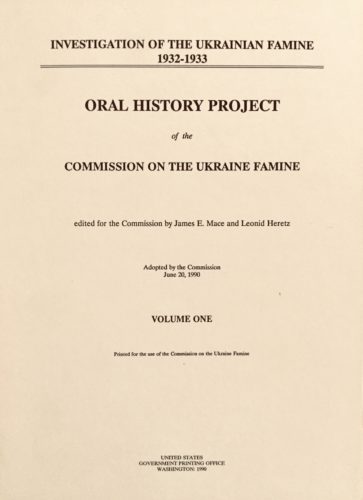
HREC worked with the Ukrainian Canadian Research and Documentation Centre (UCRDC) to digitize and preserve valuable oral testimonies collected by the U.S. Commission on the Ukraine Famine, which was established in 1986 under the direction of Dr. James Mace. Dr. Mace turned to UCRDC for assistance in gathering Famine testimonies in Canada. The entire set of 207 original recordings of oral histories was presented to the Verkhovna Rada (parliament) in Ukraine but subsequently has disappeared. The only surviving copies of the tapes are held in the archives of UCRDC. HREC funded the digitization of these tapes.
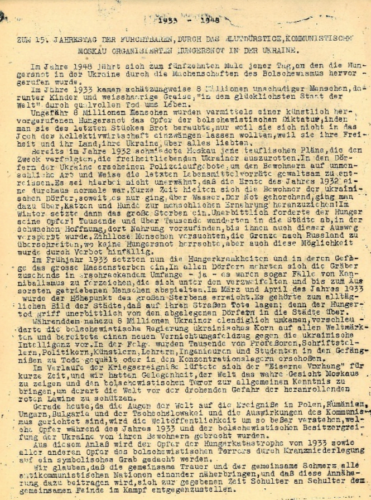
HREC is supporting the publication of 16 Holodomor memoirs from the archive of the Ukrainian Cultural and Educational Centre (Oseredok) in Winnipeg. These were gathered as part of a competition held in the late 1940s for memoirs about the Second World War. The accounts are of particular value as they were written relatively soon after the Holodomor and reflect the experiences of Ukrainian intellectuals, teachers, and other professionals. Below are examples of some of the material found in the Oseredok collection regarding the memoir competition.
HANNA KASHYNSKA | Testimony of Hanna Kashynska about the Famine of 1932–1933 in the Dnipropetrovsk region. March 10, 1950. [Scan of Ukrainian original]
HANNA KASHYNSKA | English translation of the testimony by Hanna Kashynska about the Famine of 1932–1933 in the Dnipropetrovsk region. March 10, 1950.
K. PETRUS | Cover of K. Petrus’ “Soviet Arrestees.” 1944–1947. [Scan of Ukrainian original]
K. PETRUS | English translation of the testimony by K. Petrus in “Soviet Arrestees”, 1944–1947. [Ukrainian transcription]
FEDIR PRAVOBEREZHNYI (PIGIDO) | Biography of Fedir Pravoberezhny (Pigido). [Ukrainian]
FEDIR PRAVOBEREZHNYI (PIGIDO) | Cover of Pravoberezhnyi’s book “8 000 000. The Year 1933 in Ukraine.” 1948. [Scan of Ukrainian original]
FEDIR PRAVOBEREZHNYI (PIGIDO) | Dedication Pravoberezhnyi’s book “8 000 000. The Year 1933 in Ukraine.” 1948. [Scan of Ukrainian original]
FEDIR PRAVOBEREZHNYI (PIGIDO) | “8 000 000. The Year 1933 in Ukraine.” [Ukrainian transcription]
FEDIR PRAVOBEREZHNYI (PIGIDO) | Article by Fedir Pravoberezhny (Pigido) “17th Anniversary of the Holodomor” in Ukrainianski visti, June 8, 1950. [Scan of Ukrainian original]
V. SEBASTIANOV | Testimony of V. Sebastianov about the Famine of 1932-1933 in Vinnytsia. July 14, 1947. [Ukrainian transcription]]
V. SEBASTIANOV | Letter from V. Sebastianov to Oseredok. July 18, 1947. [Scan of Ukrainian original]
IVAN ZOZIULA | Biography of Ivan Zozulia (Ivan Piddubnyi). [Ukrainian]
IVAN ZOZIULA | Testimony by Ivan Zozulia “Part I: The Truth About the Collective Farm.” January 22, 1948. [Ukrainian transcription]
IVAN ZOZIULA | Testimony by Ivan Zozulia “Part II: In the Yoke of the Collective Farm.” January 22, 1948. [Ukrainian transcription]
OTHER MATERIALS | Flyer in English distributed by Ukrainian participants at an April 11, 1948 demonstration in Hanover, Germany, on the occasion of the fifteenth anniversary of the Famine of 1932–1933 in Ukraine. Not later than April 11, 1948. Original, typed.
OTHER MATERIALS | Badge worn by participants at a demonstration in Hanover, Germany, on the occasion of the 15th anniversary of the Famine of 1932–1933 in Ukraine. Not later than April 11, 1948. Original, colour image. The symbol is glued to the page; it appears that the typed description accompanying the badge was made by D. Solovei.
OTHER MATERIALS | Flyer in German distributed by Ukrainian participants at an April 11, 1948 demonstration in Hanover, Germany, on the occasion of the fifteenth anniversary of the Famine of 1932–1933 in Ukraine. Not later than April 11, 1948. Original, typed.
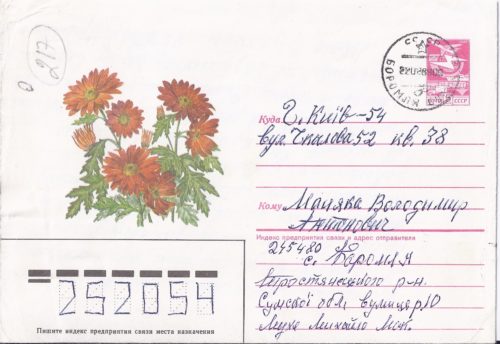
HREC’s Maniak Collection contains valuable witness accounts gathered in the late 1980s by journalist Volodymyr Maniak. Maniak received thousands of accounts from survivors of the Holodomor after he published appeals for memoirs in Ukrainian newspapers. The HREC collection contains scans of the original letters and accounts, most of which are accompanied by a transcript. A selection of the accounts have also been translated into English. The database offers an array of searchability options.